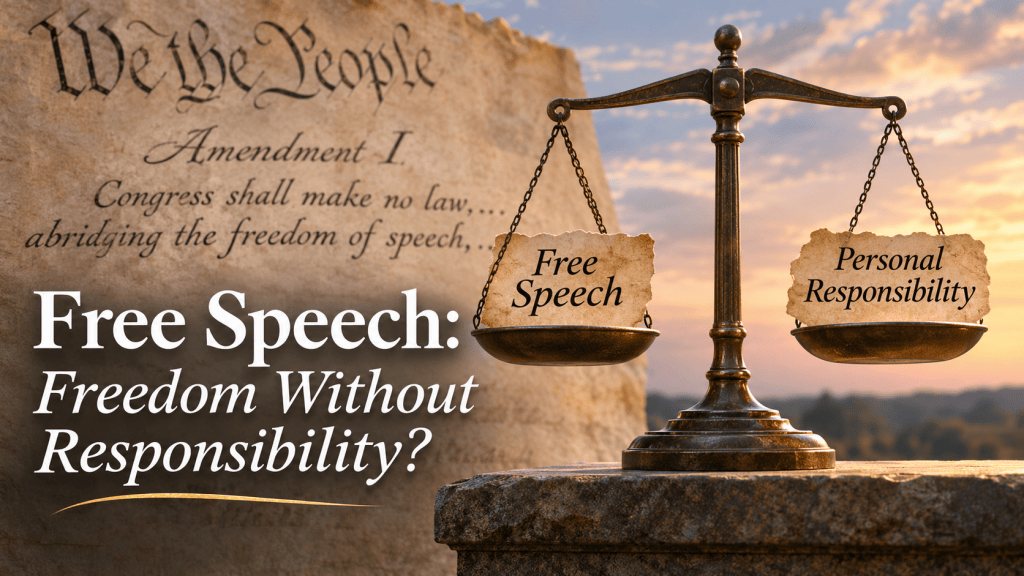
Freedom of speech is one of the freedoms we enjoy in the United States that I believe we should particularly cherish and vigorously defend.
However, I sometimes wonder whether we’ve lost sight of what freedom of speech actually means.
It seems to me that a LOT of people interpret freedom of speech to mean they can say whatever they want, about whomever or whatever they want, and should be able to do so with impunity. Is that really what the First Amendment provides?
And even if it did, would that relieve us of our responsibility to consider the consequences our words have on others?
What Does the First Amendment Actually Say?
In keeping with the philosophy I discussed in my previous essay, Trust but Verify, perhaps we should begin by going directly to the source.
The First Amendment to the United States Constitution, ratified on December 15, 1791, reads:
Congress shall make no law respecting an establishment of religion, or prohibiting the free exercise thereof; or abridging the freedom of speech, or of the press; or the right of the people peaceably to assemble, and to petition the Government for a redress of grievances.
What strikes me about the wording of the First Amendment is that it begins by establishing a restriction on the government rather than granting individuals immunity from the consequences of their actions. I think that’s an important distinction.
Although the amendment specifically references Congress, its free speech protections have, through subsequent constitutional interpretation and application of the Fourteenth Amendment, been extended to actions of state and local governments as well. And while the freedom to criticize our government is certainly an important aspect of freedom of speech, the protections afforded by the First Amendment extend well beyond political speech.
We are generally free to express our opinions, question established beliefs, criticize those in positions of authority, challenge societal norms and express views that others may find unpopular or even offensive.
And I believe we should be.
But does that mean we should be immune from the consequences of doing so?
The Historical Context
I think it’s worth giving some consideration to the circumstances under which the First Amendment was developed.
Our Founders had experienced British rule and had fought a war to establish their independence. In creating a new government, there was considerable concern about granting that government powers that could be used to infringe upon the liberties of its citizens. Among those concerns was the potential for government authorities to suppress criticism and restrict the dissemination of information and ideas.
In a letter to James Madison dated July 31, 1788, more than three years before the ratification of the First Amendment, Thomas Jefferson expressed the view that protecting the freedom of the press from government restraint need not relieve printers of liability for publishing false information. Jefferson’s views shouldn’t necessarily be interpreted as representing those of all the Founders. Their views regarding the scope and limitations of freedom of speech were not identical.
Nevertheless, I find it interesting that the distinction between freedom of expression and accountability for what we express was being considered even before the First Amendment was ratified.
The technology through which we communicate may have changed dramatically over the past two centuries, but some of the ethical questions surrounding what we communicate have not.
Freedom of Speech or Freedom from Consequences?
Let’s consider a few hypothetical situations.
Suppose I express an opinion about a controversial subject and someone disagrees with me. They subsequently express their disagreement publicly.
Has my freedom of speech been violated? No. They’re simply exercising the same freedom that I exercised when expressing my opinion.
Suppose I write a letter to the editor of a privately owned newspaper and the editor chooses not to publish it.
Has my freedom of speech been violated? Generally speaking, no. My freedom to express my opinion doesn’t obligate someone else to provide me with a means of disseminating it.
Suppose I say something that causes a longtime friend to lose respect for me or perhaps even end our friendship.
Has my freedom of speech been violated? Again, no. I’m free to say what I choose, but my friend is equally free to determine how they respond to what I’ve said.
Now suppose I knowingly make a false statement about someone that damages their reputation and causes them to lose their job or suffer financial hardship. Can I simply invoke my First Amendment rights and expect to be immune from legal consequences?
No. Depending upon the circumstances, I may be held legally liable for defamation.
That’s not to suggest that every false statement is unlawful, but rather that the First Amendment doesn’t provide blanket immunity from liability for the harm caused by defamatory statements.
There are, of course, numerous legal considerations and exceptions associated with the First Amendment. I’m not an attorney, nor is my objective here to provide an extensive interpretation of constitutional law.
My point is considerably simpler.
Freedom of speech does not necessarily mean freedom from the consequences of our speech.
And perhaps more importantly, the fact that something we say is constitutionally protected doesn’t necessarily mean it was appropriate for us to say it.
The Potential for Harm
I wonder how often we stop to consider the potential consequences of our words before we speak them. Or, perhaps more appropriately in today’s world, before we type them.
In the age of social media, we have the ability to disseminate information to an audience of a size that previous generations could hardly have imagined. Within minutes, something we say about another person can potentially be seen by thousands of people, many of whom may then share it with thousands of others.
And what if what we’ve said isn’t true?
What if, as a result of something we’ve said, someone loses their job? What if their business suffers? What if their relationships with friends and family are damaged? What if their reputation, which may have taken a lifetime to establish, is severely damaged in a matter of days or even hours?
And what if we subsequently discover that the information we shared was inaccurate? We can retract our statement. We can apologize. We can acknowledge that we were wrong. But can we undo the damage?
Will everyone who saw the original statement also see the correction? Will everyone who formed an opinion of that individual based upon what we said reconsider that opinion? I suspect that in many cases the answer is no.
As I discussed in Trust but Verify, I believe we have a responsibility to make a reasonable effort to verify the accuracy of information before disseminating it. The greater the potential for harm, the greater I believe that responsibility becomes.
And yet, I sometimes get the impression that people devote considerably more thought to the reaction they’re hoping to generate than to the damage they might cause.
But What If It’s True?
Of course, not everything we say that causes harm to another person is inaccurate.
There may be circumstances in which what we’re saying is absolutely true. Does that necessarily make it appropriate for us to say it?
I don’t think so.
As I discussed in my earlier essay, Same Facts. Different Words. Different Conclusions, even factually accurate information can be presented in a manner that leads others to an inaccurate conclusion.
There are certainly situations in which sharing information about another person is appropriate, even if doing so results in undesirable consequences for that person. Exposing wrongdoing, warning others of a legitimate danger and holding people accountable for their actions are a few examples.
The potential for harm to someone’s reputation should not, in and of itself, prevent us from speaking out when there is a legitimate reason to do so. But what if our primary motivation for sharing the information is simply to embarrass or humiliate someone? What if sharing it serves no constructive purpose whatsoever? What if we’re doing so simply because we can?
Perhaps we should spend a little more time examining our motivation for saying something rather than simply determining whether we have the right to say it. Is it my intention to inform someone? To protect someone? To contribute to a meaningful discussion? To address a problem? Or is it my intention to hurt someone, embarrass someone, make myself look better at someone else’s expense or simply generate a reaction?
And if I’m being truthful with myself about my motivation, might I occasionally come to the conclusion that what I’m about to say would be better left unsaid?
Having the Right Doesn’t Necessarily Make It Right
I believe there’s a considerable difference between having the right to do something and it being the right thing to do. And I wonder how often we confuse the two.
When considering whether to say something, perhaps we should be asking ourselves a few questions.
- Am I legally permitted to say it?
- Is what I’m about to say true?
- Is it appropriate for me to say it?
- What purpose will be served by saying it?
- What consequences might it have for others?
- What consequences might it have for me?
And am I willing to accept responsibility for those consequences?
Unfortunately, I sometimes wonder whether we stop after answering the first question.
I don’t believe the First Amendment was intended to serve as a substitute for good judgment, common decency or personal responsibility. Nor do I believe we should have to rely on the government to establish the boundaries of acceptable behavior in every aspect of our lives. Isn’t that, at least in part, what having a conscience is all about?
In my earlier essay, When Did Disagreement Become Disrespect?, I suggested that not every opinion needs to be expressed simply because we have one.
That doesn’t mean I believe we should be discouraged from expressing our opinions. Quite the contrary. I believe the free exchange of ideas and opinions, particularly differing opinions, can be extremely beneficial.
But there is a considerable difference between someone else restricting what I can say and my voluntarily choosing not to say something. The latter isn’t a surrender of my freedom of speech. It’s an exercise of that freedom.
The freedom to say something also includes the freedom to choose not to say it.
Perhaps there’s some wisdom in the words of Ecclesiastes, written centuries before our Constitution: “A time to be silent and a time to speak.” (Ecclesiastes 3:7, NIV)
Are More Laws the Answer?
When we see people exercising their freedom of speech irresponsibly, particularly when their words cause considerable harm to others, it’s understandable that we might look for ways to prevent that behavior. One possible solution is to enact additional laws restricting what people can say.
But is that necessarily the best solution? I’m not convinced that it is.
We already have laws that provide certain protections and remedies for people who have been harmed by the words of others. Could those laws be improved? Perhaps. But I’m concerned about the potential consequences of relying increasingly upon the government to determine what we should and shouldn’t be permitted to say.
Who determines whether something is true? Who determines whether an opinion is appropriate? Who determines whether someone’s criticism of another individual, a business or a government official is legitimate? And what happens if those entrusted with making those determinations abuse that authority?
I would be particularly concerned about creating an environment in which people with legitimate concerns are reluctant to express them for fear of legal repercussions. We wouldn’t want to discourage someone from exposing wrongdoing simply because they haven’t yet been able to establish all the facts necessary to prove their allegations. Nor would we want to discourage the expression of unpopular opinions simply because those in positions of authority happen to disagree with them. After all, isn’t protecting our ability to express such views one of the reasons we cherish freedom of speech in the first place?
I don’t want to see us undermine the very freedom we’re trying to preserve in our efforts to address its irresponsible exercise.
Our Responsibilities to One Another
If additional government restrictions aren’t necessarily the answer, then what is? Perhaps part of the answer lies in rediscovering our sense of responsibility to one another.
I would much prefer to live in a society in which people refrain from deliberately making false and damaging statements about others, not because they’re afraid of being sued, but because they believe doing so is wrong.
Likewise, I would prefer to live in a society in which people exercise consideration for others, not because they’re required to do so, but because they genuinely care about how their words and actions affect others.
As I discussed in Finding Joy by Bringing Joy to Others, being considerate of others can benefit us as well as those toward whom we’re being considerate.
Is that an unrealistic expectation? Maybe. But I don’t think that makes it any less worthy of pursuing. I also believe there is a role for social accountability.
Just as we should be willing to acknowledge and encourage honesty, kindness and consideration for others, we should be willing to express our disapproval of dishonest, malicious and irresponsible behavior.
But we need to be careful here as well. There is a fundamental difference between holding someone accountable for knowingly spreading false information about another person and punishing someone simply because we disagree with their opinion.
In our efforts to encourage responsible speech, we need to be careful not to discourage the expression of legitimate opinions through social intimidation. And we certainly shouldn’t excuse irresponsible behavior simply because the person engaging in it happens to share our political, religious or philosophical beliefs.
How consistent are we in applying our standards of acceptable behavior? Are we as willing to express our disapproval of the behavior of someone whose opinions we generally agree with as we are of the behavior of someone whose opinions we generally disagree with? I suspect that’s a question many of us, myself included, would benefit from asking ourselves occasionally.
There is considerably more to be explored regarding the role of societal standards and social accountability, particularly in the age of social media. I’ll leave that discussion for a future essay. For now, I’d simply suggest that the responsibility for encouraging responsible behavior doesn’t necessarily rest with the government alone. Perhaps it rests, to a considerable extent, with us.
Are We Inviting Restrictions on Our Own Freedoms?
There’s another aspect of this subject that concerns me, and it extends well beyond freedom of speech.
I sometimes wonder whether, in our reluctance to accept personal responsibility, we’re encouraging the government to assume responsibilities that should be ours. That’s not to suggest that government doesn’t have a legitimate role in protecting individuals from harm. It certainly does. But where should we draw the line between the government’s responsibility to protect us and our responsibility to conduct ourselves appropriately?
Do we really want the government determining what constitutes acceptable behavior in every aspect of our lives?
Consider what might happen if enough people exercise a particular freedom irresponsibly. As more people suffer the consequences of that irresponsible behavior, it’s understandable that they might become increasingly frustrated and eventually look to the government to address the problem. The government may respond by imposing additional restrictions on the exercise of that freedom.
And who might find themselves subject to those restrictions? Not just those who have exercised their freedom irresponsibly, but potentially those who have exercised it responsibly as well.
Is it possible that our unwillingness to accept the responsibilities that accompany our freedoms could ultimately jeopardize those very freedoms? And if we encourage the government to assume responsibilities that we should be willing to accept ourselves, should we be surprised when doing so results in limitations on some of the freedoms we cherish?
Perhaps personal responsibility is more than simply a moral obligation. Perhaps it’s also an important part of preserving our freedoms.
A Freedom Worth Preserving
I want to be clear that I am not suggesting we should be less willing to express our opinions, challenge conventional thinking, question those in positions of authority or engage in meaningful discussions about controversial subjects. I believe our freedom to do those things is extremely important.
Nor do I believe that someone being offended by an opinion is, in and of itself, sufficient justification for attempting to silence the person expressing it. We all have different experiences, beliefs, values and perspectives. It’s inevitable that there will be times when something someone says will offend us. I don’t believe it’s reasonable to expect everyone to refrain from saying anything that might offend someone else. But I do believe it’s reasonable to expect people to give some consideration to the accuracy, appropriateness and potential consequences of their words.
We can vigorously defend someone’s right to say something without approving of what they’ve chosen to say. We can disapprove of someone’s behavior without advocating that the government prohibit that behavior. And we can choose to exercise restraint in what we say without surrendering any of our freedoms.
I don’t see those positions as being contradictory. In fact, I think they reflect an appreciation for both the freedoms we enjoy and the responsibilities that accompany them.
There’s a broader question I’ve been giving considerable thought to lately.
Have we become so focused on defending our individual rights that we’ve lost sight of our responsibilities to one another?
I suspect I’ll revisit that question in future essays because I believe it applies to many aspects of our lives. But as it relates to freedom of speech, perhaps we would all benefit from spending a little less time defending our right to say whatever we want and a little more time considering whether what we want to say is worth saying.
I cherish my freedom of speech. I hope you cherish yours. And I hope we’re both willing to accept the responsibilities that accompany it. After all, if we’re unwilling to exercise our freedoms responsibly, can we reasonably expect to preserve them indefinitely?

