I sometimes wonder whether we’ve become intellectually lazy.
It seems to me that when we’re presented with information that supports our existing beliefs, we’re often inclined to accept it without question. When presented with information that challenges those beliefs, we’re equally inclined to dismiss it without question. Neither response requires much effort on our part.
Am I a little jaded? Perhaps.
I’ll admit that I sometimes get frustrated, even angry, when someone shares information that turns out to be inaccurate. Carelessly sharing inaccurate information can be inconsiderate, irresponsible, and, in some cases, devastating. But what bothers me most isn’t necessarily the inaccuracy of the information. It’s the apparent lack of effort on the part of the person sharing it to determine whether it’s accurate.
And, of course, there are those who knowingly report inaccurate or misleading information in an effort to influence our opinions, slant a story, generate an emotional reaction, or simply attract attention.
But before I get too comfortable criticizing others, perhaps I should ask myself a question.
How often have I been guilty of doing the very thing that frustrates me about others?
Have We Become Intellectually Lazy?
We live in an extraordinary time. Most of us have, at our fingertips, access to more information than we could possibly consume in a lifetime. Many questions can be answered easily and quickly. Many claims can be investigated with relatively little time and effort.
Years ago, verifying something we heard might have required a trip to the library, a few telephone calls, and/or a considerable amount of time and research. Today, we can often begin that process in a matter of seconds.
Yet I wonder whether our increased access to information has been accompanied by a corresponding increase in our willingness to evaluate it.
I suspect not.
Perhaps we’ve become complacent. Perhaps we’re overwhelmed by the sheer volume of information we’re exposed to. Perhaps we’ve become too comfortable relying on certain individuals or organizations to tell us what we should believe.
Or perhaps we’re simply reluctant to discover that something we’ve believed for years might be wrong.
There’s a term for our tendency to favor information that supports our existing beliefs. It’s called confirmation bias. And I suspect very few of us are immune to it.
What’s particularly interesting to me is that we can exercise very little critical thinking in either accepting or rejecting information. If we’ve already decided what we want to believe, there’s not much incentive to investigate further.
Are we interested in discovering the truth, or are we simply interested in finding information that confirms what we already believe?
Mistakes, Carelessness, and Dishonesty
I think there’s an important distinction between making an honest mistake, carelessly passing along inaccurate information, and deliberately misleading someone.
We’ve all made honest mistakes. We can make a sincere effort to understand something and still reach an incorrect conclusion. I certainly don’t expect perfection from others, nor should they expect it from me.
But I have considerably less patience with someone who presents information as fact without making a reasonable effort to determine whether it’s accurate. And I have even less patience with someone who knowingly presents misleading information to further an agenda or generate a particular reaction.
Unfortunately, it’s not always possible to determine which of those three circumstances applies when we’re presented with inaccurate information. We don’t necessarily know what effort someone made to verify it or what their intentions were in sharing it.
Which is all the more reason to evaluate the information itself.
A Higher Standard of Accountability
It should be noted that I don’t necessarily hold everyone to the same standard when it comes to the accuracy of the information they share.
If a friend, an associate, or even a casual acquaintance passes along something inaccurate, I might question the effort they made to verify it, but I don’t necessarily expect them to have the training, resources, or expertise of someone whose profession is to gather and disseminate information.
I do, however, have considerably higher expectations of those in the news media. After all, isn’t that their job?
I’m not suggesting that professional journalists should never make mistakes. After all, they’re human, just like the rest of us. But I do expect them to make a greater effort to verify information before presenting it as fact. And when they discover they’ve made a mistake, I expect them to make a reasonable effort to correct it.
I also wonder whether the competition to be the first to report a story has, at times, become more important than the responsibility to report it accurately. What value is there in being the first to report a story if the information being reported is inaccurate? Personally, I’d rather wait a little longer for accurate information than be among the first to receive inaccurate information.
And while I have no objection to someone in the media expressing an opinion, I’d appreciate knowing when I’m being presented with an opinion rather than a fact. There’s certainly a place for editorial commentary, analysis, and discussion. Those things can help us better understand complicated issues and consider perspectives we might not otherwise have considered. But I think there’s a responsibility on the part of those presenting the information to make a clear distinction between reporting the news and offering their opinions about it.
And there’s a responsibility on our part to recognize that distinction.
You Don’t Have to Lie to Mislead
As I discussed in an earlier essay, Same Facts. Different Words. Different Conclusions., the manner in which information is presented can have a significant influence on the conclusions we draw from it.
But there’s another aspect of that worth considering.
Someone can present information that is entirely factual and still leave us with a misleading impression. They can omit relevant facts. They can selectively present statistics. They can quote someone out of context. They can present an opinion in such a manner that it appears to be an established fact.
Imagine being asked to form an opinion about a disagreement between two people after hearing only one person’s account of what happened. Everything that person told you might be true. But would you necessarily have enough information to reach a fair conclusion?
Probably not.
Yet how often do we do essentially the same thing when consuming information from the news media or the internet?
Perhaps we should be asking not only whether what we’re being told is true, but whether we’re being told enough of the truth to reach an informed conclusion.
I also wonder how often we stop to consider what someone hopes to accomplish by presenting us with a particular piece of information.
Are they trying to inform us? Educate us? Persuade us? Sell us something? Make us angry? Frighten us? When something I read or hear generates a particularly strong emotional reaction in me, that’s probably when I should be most inclined to question it.
Unfortunately, I suspect that’s often when I’m least inclined to do so.
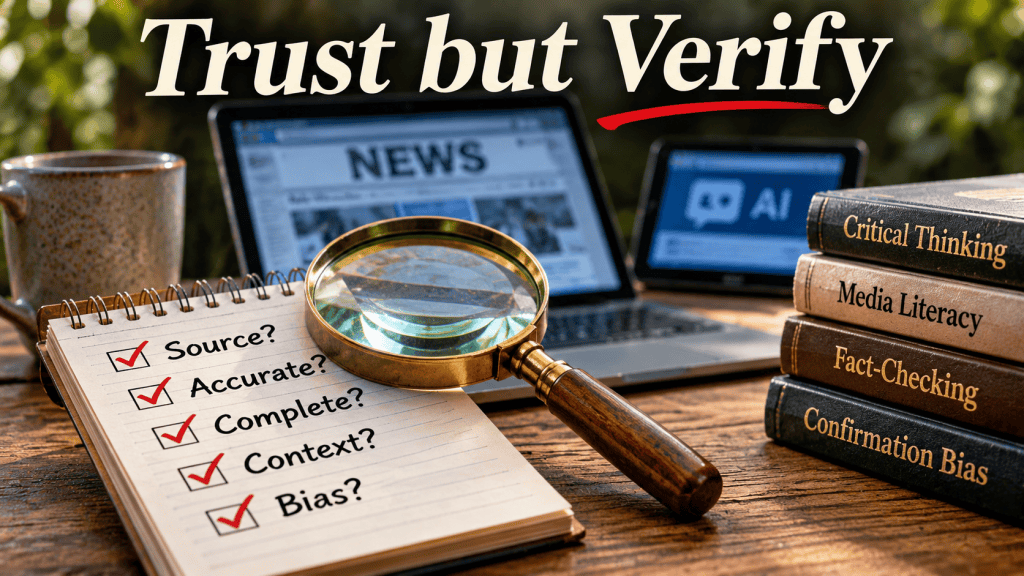
Trust but Verify
The expression Trust but Verify is one that many of us associate with Ronald Reagan and his dealings with the Soviet Union. But I think it has considerable application in our everyday lives.
I don’t think there’s anything wrong with trusting people. In fact, I think trust is an essential part of any healthy relationship. But there’s a difference between trusting someone to tell us the truth and assuming that what they’re telling us is true. Even an entirely honest person can unknowingly pass along inaccurate information.
When I’m presented with information that I find questionable, one place I don’t go to verify it is social media. It seems to me that far too much of what is presented on social media is shared with little or no apparent effort to verify its accuracy. Much of it appears to be intended to promote a particular point of view, generate an emotional response, or produce some financial benefit.
Instead, I will typically conduct an internet search, consult artificial intelligence, and, when appropriate, check at least two television news sources that I recognize as having opposing biases.
Why opposing biases?
Because I’m interested not only in what each source is telling me, but also in what each might be leaving out.
Now, I’m not suggesting that if two news organizations present differing accounts of the same event, the truth necessarily lies somewhere in the middle. One may be right and the other wrong. Both may be wrong. And finding five websites that report the same information doesn’t necessarily mean I’ve independently verified it. All five may have obtained their information from the same original source.
So, whenever practical, it makes sense to go directly to the original source. Read the actual legislation. Watch the entire interview. Examine the original report or study rather than relying exclusively on someone else’s interpretation of it.
I’ve also found artificial intelligence to be a valuable tool in researching subjects and evaluating information. But AI can make mistakes, too. It would be somewhat ironic for me to write an essay encouraging people to verify information and then suggest they accept whatever AI tells them without question.
These are all tools available to help us reach informed conclusions, but none of them relieves us of the responsibility to think for ourselves.
Questioning What We Want to Believe
I suspect that most of us are considerably more inclined to question information that challenges our beliefs than information that supports them.
In fact, I wonder whether we sometimes do just the opposite of what we should be doing. Rather than examining our beliefs in light of new information, we examine new information in light of our existing beliefs.
Imagine reading a news story that is highly critical of a politician you particularly dislike. The story reinforces everything you’ve believed about that individual. You might even derive a certain amount of satisfaction from reading it.
Now imagine reading that same story, but this time it’s about a politician you admire. Would you be equally inclined to question the accuracy of both stories? Would you make the same effort to verify them? And would you be equally inclined to share them with others?
I think those are questions worth asking ourselves.
Of course, this isn’t limited to politics. It applies to our religious beliefs, our views on health and nutrition, our opinions about businesses and organizations, and even our perceptions of people we know personally.
Perhaps the information we should be most careful to verify is the information we’re most eager to believe.
What’s Wrong with Being Wrong?
If I’ve made an extensive effort to verify something and discovered that a belief I’ve held is incorrect, I’m willing to accept it. After all, what would have been the point of making that effort if I wasn’t willing to accept what I discovered?
I wonder why we sometimes perceive changing our minds as a sign of weakness. It seems to me that acknowledging we were wrong requires considerably more character than continuing to defend a position we can no longer justify.
And if I’m discussing the subject with someone who still holds the belief I once held, I’ll share what I’ve learned. I’ll also share the sources of that information so they have an opportunity to examine it for themselves.
What they choose to do with that information is entirely up to them. I’m not asking them to accept my conclusions simply because I’ve reached them. That would be somewhat contrary to the point I’m trying to make. I’d much rather they arrive at their own conclusions after examining the information than simply accept mine.
And if we still disagree?
So be it. It doesn’t change my relationship with them.
As I discussed in my earlier essay, When Did Disagreement Become Disrespect?, we don’t have to agree with someone to respect them.
The Potential for Harm
How often do we consider the potential consequences of sharing inaccurate information? Probably not often enough. After all, sharing inaccurate information can damage someone’s reputation, destroy a friendship, create unnecessary fear, deepen divisions, or influence important decisions.
Imagine someone making an inaccurate statement about you. That information is shared with others who, in turn, share it with still others. Before long, people you’ve never even met have formed an opinion about you based on something that simply isn’t true.
How do you undo that damage? Is that even possible?
Or consider someone who makes an important decision regarding their health or financial well-being based on inaccurate information that was passed along by someone they trusted. The person who shared that information may have had the best of intentions. But that doesn’t necessarily lessen the consequences for the person who acted on it.
In my previous essay, Finding Joy by Bringing Joy to Others, I discussed the butterfly effect and how a seemingly insignificant act of kindness might have consequences far beyond what we could ever imagine. Does the butterfly effect apply here, too? Could something we share casually, perhaps without giving it much thought, have consequences far beyond anything we intended or imagined? Probably.
And, just as with those small acts of kindness, we may never know how far the effects of our actions travel.
The absence of an intention to cause harm doesn’t necessarily mean that no harm was done.
Which brings me to the question of our responsibility to others.
Our Responsibility to Others
With the advent of social media, many of us have acquired the ability to disseminate information to a considerable number of people in a very short time with very little effort. A few seconds and a couple of taps on a screen, and something we’ve read can be on its way to dozens, hundreds, or perhaps thousands of other people.
Interestingly, a 2018 study by MIT researchers found that false news spread faster and farther than true news on Twitter.
I wonder whether we’ve given enough thought to the responsibility that comes with that ability.
Suppose someone shares a story on social media. It supports our beliefs, so we share it with others without making any effort to verify it. We subsequently discover that the story was inaccurate. Does the fact that we didn’t know it was inaccurate absolve us of all responsibility for having shared it? What if we could have determined that it was inaccurate with just a few minutes of effort?
And now that we know it was inaccurate, do we have some responsibility to correct the misinformation we’ve helped spread?
Are we as willing to share information that proves us wrong as we were to share information that appeared to prove us right?
I don’t think we need to conduct an exhaustive investigation of everything we share with others. But I do think we owe them a reasonable effort, particularly when the information we’re sharing could influence their decisions, their opinions of others, or their understanding of an important issue. Perhaps before we hit that share button, we should ask ourselves whether we’ve made enough of an effort to determine that what we’re about to share is accurate.
And if we haven’t, what’s the harm in waiting until we have?
What’s Wrong with Saying “I Don’t Know”?
How often do we see opinions being expressed before all the facts are in? Perhaps a better question is: How often do we do that ourselves? (Hint: The answer is VERY often.)
Consider what frequently happens when a major news story breaks. Before many of the facts have been established, people are already assigning blame, questioning motives, drawing conclusions, and expressing remarkably strong opinions.
And it’s not just the news media.
We hear one side of a disagreement between two friends and form an opinion about who’s at fault. We observe someone’s behavior and assume we understand their motivation. We hear a portion of a conversation and draw conclusions without knowing its context.
I wonder why we sometimes feel compelled to form an opinion when we don’t have enough information to form an informed one. What’s wrong with saying, “I don’t know”? Or, for that matter, “I haven’t looked into it enough to have an opinion.”
We don’t have to accept or reject every piece of information we’re presented with. Nor do we have to investigate every claim we encounter. Sometimes the most reasonable thing we can do is simply reserve judgment. And even when we’ve made a reasonable effort to verify something, we should recognize the possibility that additional information may become available that changes our understanding.
Having an opinion about everything doesn’t necessarily make us knowledgeable.
It could be that recognizing the limitations of our knowledge is a better indication of wisdom.
Discovering What’s Right
Please don’t misunderstand what I’m saying. I’m not suggesting that we should go through life questioning everything and trusting no one. That doesn’t strike me as a particularly enjoyable way to live. But I do think we owe it to ourselves, and to those with whom we share information, to make a reasonable effort to distinguish fact from fiction, fact from opinion, and knowledge from assumption.
We should be willing to question information regardless of whether it supports or challenges our existing beliefs. We should be willing to acknowledge when we’re wrong. And we should be willing to accept that sometimes we simply don’t know.
We should also extend to others the courtesy of allowing them to reach their own conclusions without making their agreement with us a condition of our friendship or respect.
Sometimes our efforts to verify information will reinforce what we already believe. Sometimes they’ll cause us to change our minds. And sometimes they’ll leave us with more questions than answers.
I’m okay with all three.
After all, my objective should be to discover what’s right, not to prove that I’m right.
At least, that’s what I try to remind myself.


Leave a Reply